A line scan camera (in German: Zeilenkamera) captures image data not as a complete area but line by line. The complete image is created from the movement of the object, the material web or the camera.
That makes line scan cameras interesting for industrial applications where long, wide, continuously running or fast-moving surfaces need to be inspected. Typical examples are web materials, conveyor belts, roll goods, printed images or surface inspection in production.
Here we answer the question: Which line scan camera is right for your application? And which criteria should you clarify before comparing different models?

Markus
Sales & Business Development Manager for camera solutions at EQ Photonics
Want to get to the right line scan camera even faster?
Ask MarkusLine scan cameras: when motion is part of the image acquisition
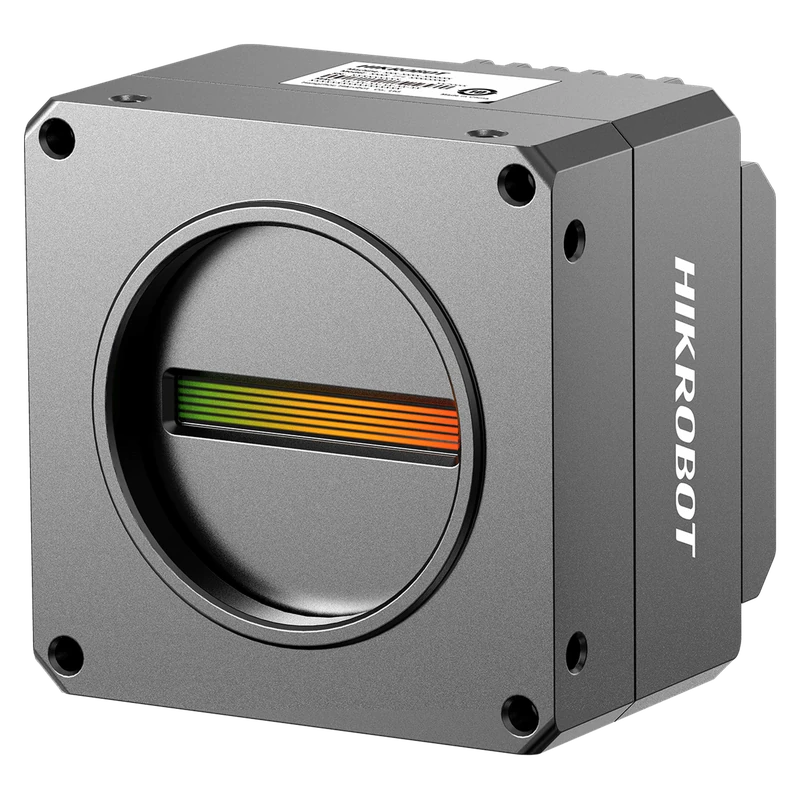
A line scan camera captures individual image lines, meaning the complete image is built from many lines. For this to work, there must be motion in the system: the object moves past under the camera, the material runs continuously through the line, or the camera is guided across a surface.
This is particularly relevant when an area is longer or wider than can sensibly be captured in a single image. Line scan can also make sense at high process speeds, because the image acquisition matches the ongoing motion.
In short: Line scan cameras are used wherever continuous processes, moving materials or long inspection objects need to be captured at high resolution. The right line scan camera depends on motion, inspection task and integration requirements.
Tips from Markus: what matters when selecting a line scan camera
Do not judge resolution in isolation. A higher resolution is not automatically the better choice. What matters is the object width to be captured, the smallest structure that must be visible, and whether optics, lighting, interface and evaluation can handle the data volume.
Consider line rate and object speed together. With a line scan camera, the acquisition must match the motion. Feed speed, the desired imaging in the direction of motion and possible synchronization via trigger or encoder should therefore be examined early.
Think about the interface early. High resolution and a high line rate generate large data volumes. Then the interface becomes relevant: for transmission, cable length, evaluation, existing hardware and integration effort.
Design camera, lens and lighting together. The camera is only one part of the image acquisition. Especially with line scan cameras, lens, lighting, surface, working distance and motion strongly influence whether an image can later be evaluated reliably.
Clarify the application before the model number. For a solid pre-selection, application data is often more helpful than a specific desired camera: inspection task, object width, smallest relevant structure, speed, surface and the existing system environment.
Still unsure about one of these points?
Ask MarkusWhich line scan camera fits? These criteria decide the pre-selection
Before comparing products, a few technical cornerstones should be clear. The most important are:
- Resolution
- Line rate
- Object speed
- Interface
- Lens
- Lighting
- Trigger or encoder
- Evaluation and system environment
These points are interlinked. Changing one of them – resolution, speed or data transmission, for instance – usually changes the requirements on other components too. It therefore pays to keep the overall system in view and not to consider the individual parameters in isolation.
Resolution: object width and smallest relevant structure
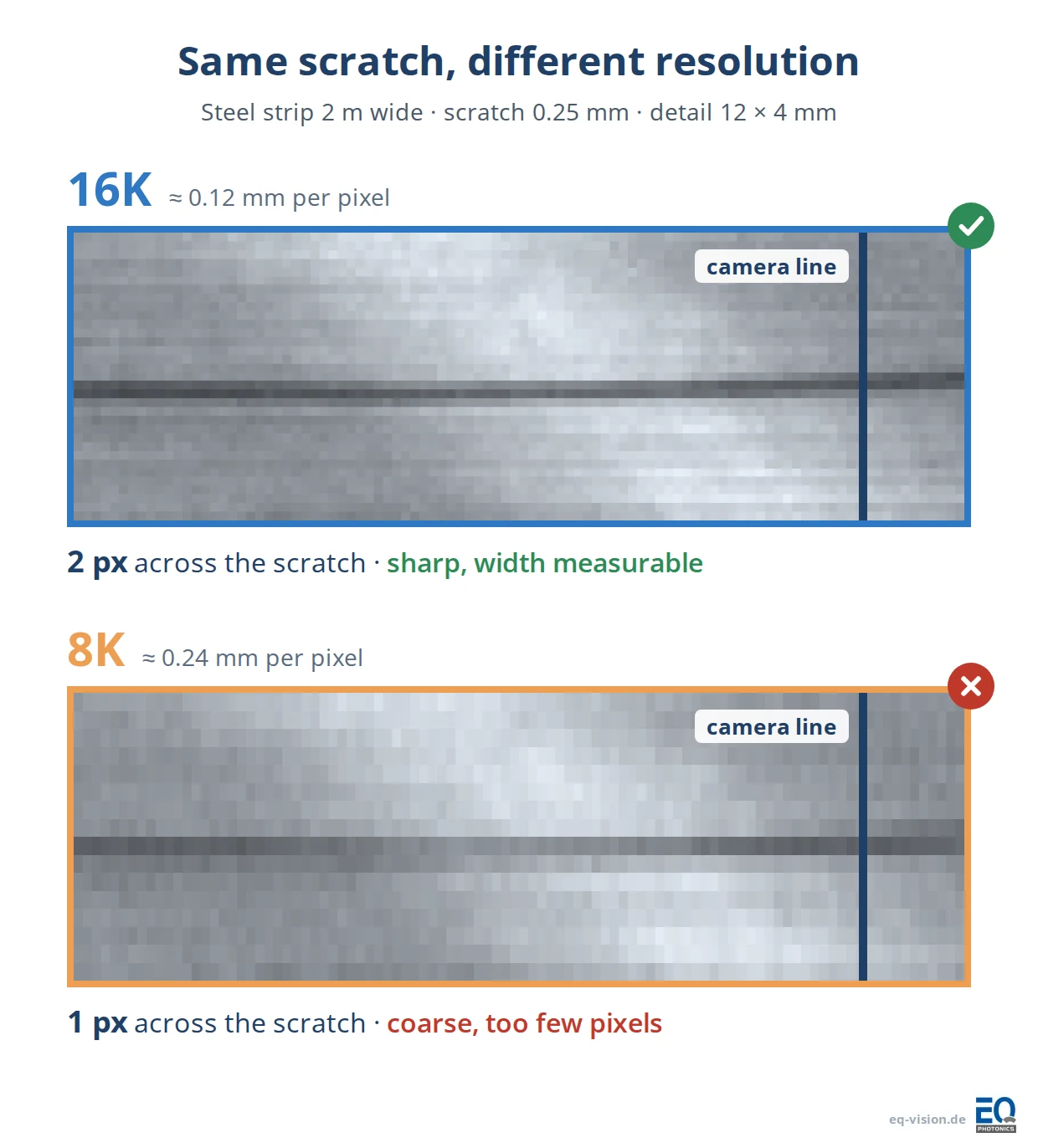
For a line scan camera, the Resolution describes how many pixels are available across the direction of motion. What matters is therefore not simply “more pixels” but the specific inspection task. The key questions are:
- How wide is the object or material?
- What is the smallest structure that must be detected?
- How much margin does the evaluation need?
- Does the desired resolution match the lens, lighting and data processing?
An example: A 16K line scan camera captures more pixels per line than an 8K line scan camera. At the same field-of-view width, smaller details can become visible or measurement tasks can be carried out with higher accuracy. Whether a 16K camera is actually the right choice cannot be answered across the board, however. What always decides are the requirements of the application – such as object size, desired detail recognition and the overall system design.
Line rate: matching acquisition and object speed
The Line rate describes how many image lines per second can be captured. It must match the speed of the object or material. If material runs fast, the camera must capture correspondingly many lines – otherwise the image data is not clean enough for evaluation. At the same time, the acquisition must be synchronized to the motion.
For this, triggers or encoders can become relevant – especially when the speed fluctuates or the image acquisition must match the motion exactly.
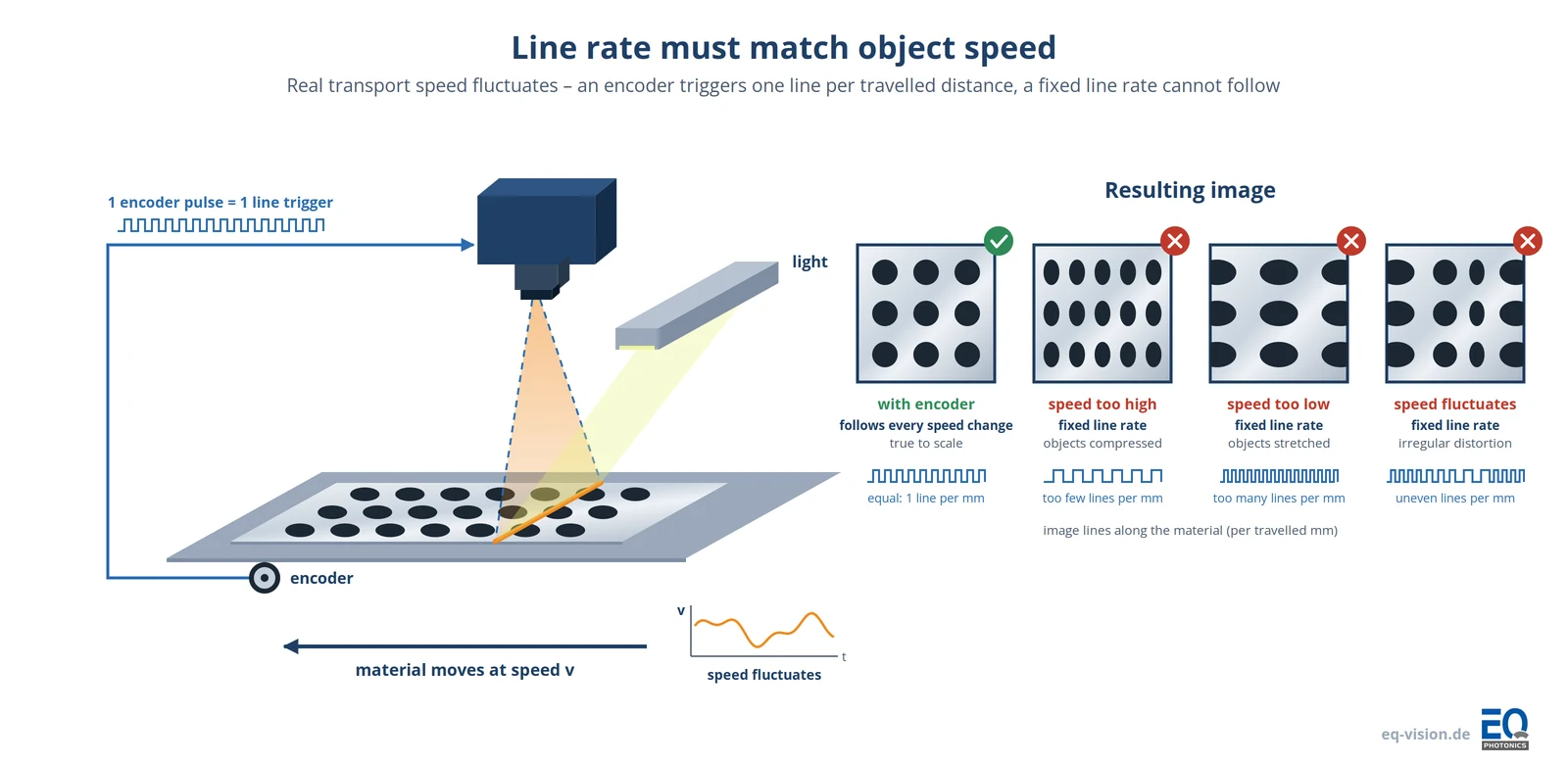
In short: The right line rate always follows from the application – from object speed, desired resolution and the image quality requirements.
Interface: checking data rate and integration
Resolution and line rate determine how much image data is generated. The interface decides whether this data can be transmitted and processed reliably. Depending on the application, different interfaces can come into question. What matters is not just speed and bandwidth, but also:
- cable length
- existing hardware
- software environment
- evaluation
- integration effort
- space in the machine
GigE (Gigabit Ethernet) can be a suitable interface depending on data rate, cable length and system environment. At higher data rates or with special integration requirements, other interfaces can be more appropriate. The right interface should therefore be checked early – not only after the camera has already been selected.
All criteria clarified?
View line scan cameras in the shopTypical applications for line scan cameras
Line scan cameras are frequently used where an object is not inspected as a single still image but passes the camera continuously. This applies to many industrial processes. Even so, the application should not be assessed by industry alone. What always decides are inspection task, object motion, surface, speed and the desired evaluation.
Surface inspection on webs and endless material
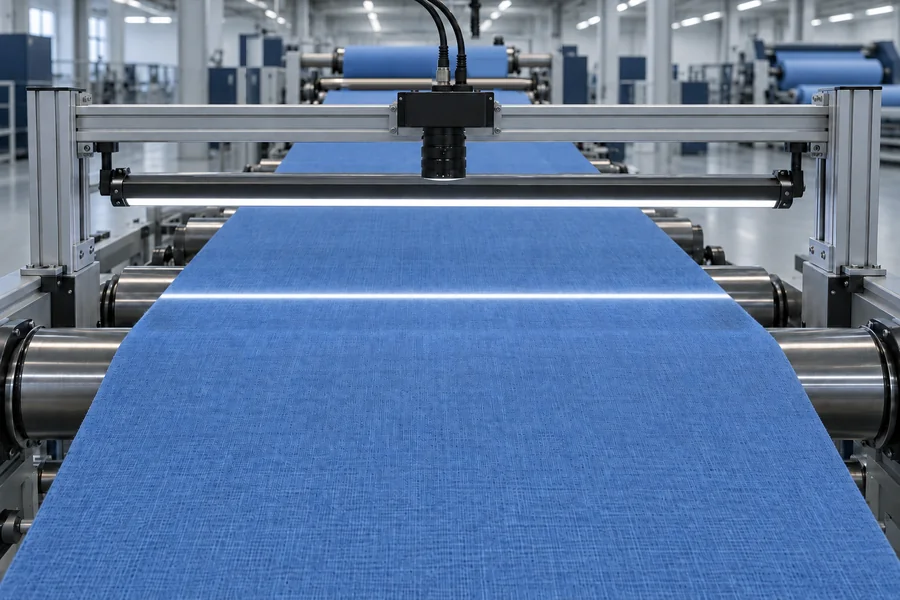
With web or endless material, the material runs continuously through the line. A line scan camera can capture it line by line and build a complete image of the surface. Typical materials include:
- films
- paper
- textiles
- metal webs
- plastic webs
- coated surfaces
Relevant selection questions:
- How wide is the material web?
- What defect size needs to be detected?
- How fast does the material run?
- What kind of surface is involved?
- Which lighting produces the right contrast?
Inspection on conveyor belts and in fast production lines
On conveyor belts, objects move through the inspection area. Line scan can make sense when the motion can be used in a controlled way and the image acquisition can be synchronized reliably. Important here are:
- conveyor speed
- object distance
- steady or fluctuating motion
- triggering
- lighting situation
- evaluation speed
If, on the other hand, individual objects are indexed and stationary or should be evaluated in one complete image, an area scan camera can also be the right choice.
When high speed and fine detail recognition come together
Especially in fast continuous processes, a line scan camera can make sense – but only if motion, synchronization and lighting are under control. This is where many projects fail: the camera fits on paper, but the process does not. With line scan, the following must be considered particularly carefully:
- transport speed
- Line rate
- encoder signal
- triggering
- Lighting
- data rate
- Interface
- evaluation
- mechanical stability
If these points do not work together, the result is distorted, blurred or non-reproducible images.
Application and requirements settled?
View line scan cameras in the shop nowLine scan or area scan?
If you are not yet sure whether a line scan camera is fundamentally the right choice for your application, you will find further tips and guidance here.
FAQ on line scan cameras
What is a line scan camera?
A line scan camera is an industrial camera that captures image data line by line. The complete image is created from the movement of the object, the material or the camera.
Is a Zeilenkamera the same as a line scan camera?
Yes. Zeilenkamera is the German term, line scan camera the commonly used English term. Both describe cameras that build an image from individual lines.
What does line rate mean for a line scan camera?
The line rate describes how many image lines per second can be captured. It must match the speed of the object or material.
How can EQ Photonics help with selecting a line scan camera?
Markus reviews your specific application together with you and helps identify technical risks early. You receive a well-founded assessment of which combination of camera, optics and lighting makes sense for the inspection task and which information is critical for a successful implementation. Helpful details include inspection task, object width, smallest structure, speed, surface and the existing system environment. You get a solid pre-selection of suitable line scan cameras faster, instead of having to work through countless technical variants on your own.

Not sure which line scan camera fits your application?
“When I select a line scan camera, I do not start with the model number but with the application. What needs to be detected? How wide is the material? How fast does the process run? What kind of surface is involved? And which evaluation has to work reliably in the end? Only once these points are clear can you meaningfully narrow down which line scan camera fits.”
For a first assessment, the most helpful details are: inspection task, object or material width, smallest relevant structure, speed, steady or fluctuating motion, surface and material, existing lighting, optics or camera, interface or software environment, and the installation situation and available space.
If you want to review a specific application:
Check feasibility with Markus now Send inquiry