
Anyone selecting a camera for industrial machine vision quickly runs into a fundamental question: area scan or line scan?
- What are the differences between area scan and line scan cameras?
- Which applications is each designed for?
- And how do you tell which acquisition principle fits your process better?
These are exactly the questions we get to the bottom of here.

Markus
Sales & Business Development Manager for camera solutions at EQ Photonics
Not sure whether line scan or area scan fits your task?
Ask MarkusWhat fundamentally distinguishes area scan and line scan cameras
The two camera types solve different tasks. A line scan camera is not automatically better. An area scan camera is not automatically simpler.
An area scan camera, sometimes called a frame camera, captures a complete area in a single image. This is often the right fit when an object is inspected at a defined position or when several features are to be evaluated in one overall image.
A line scan camera, sometimes called a line camera, captures the image line by line. The complete image is built up from the movement of the object or material. This becomes interesting when continuously moving, long, wide or endless surfaces need to be inspected.
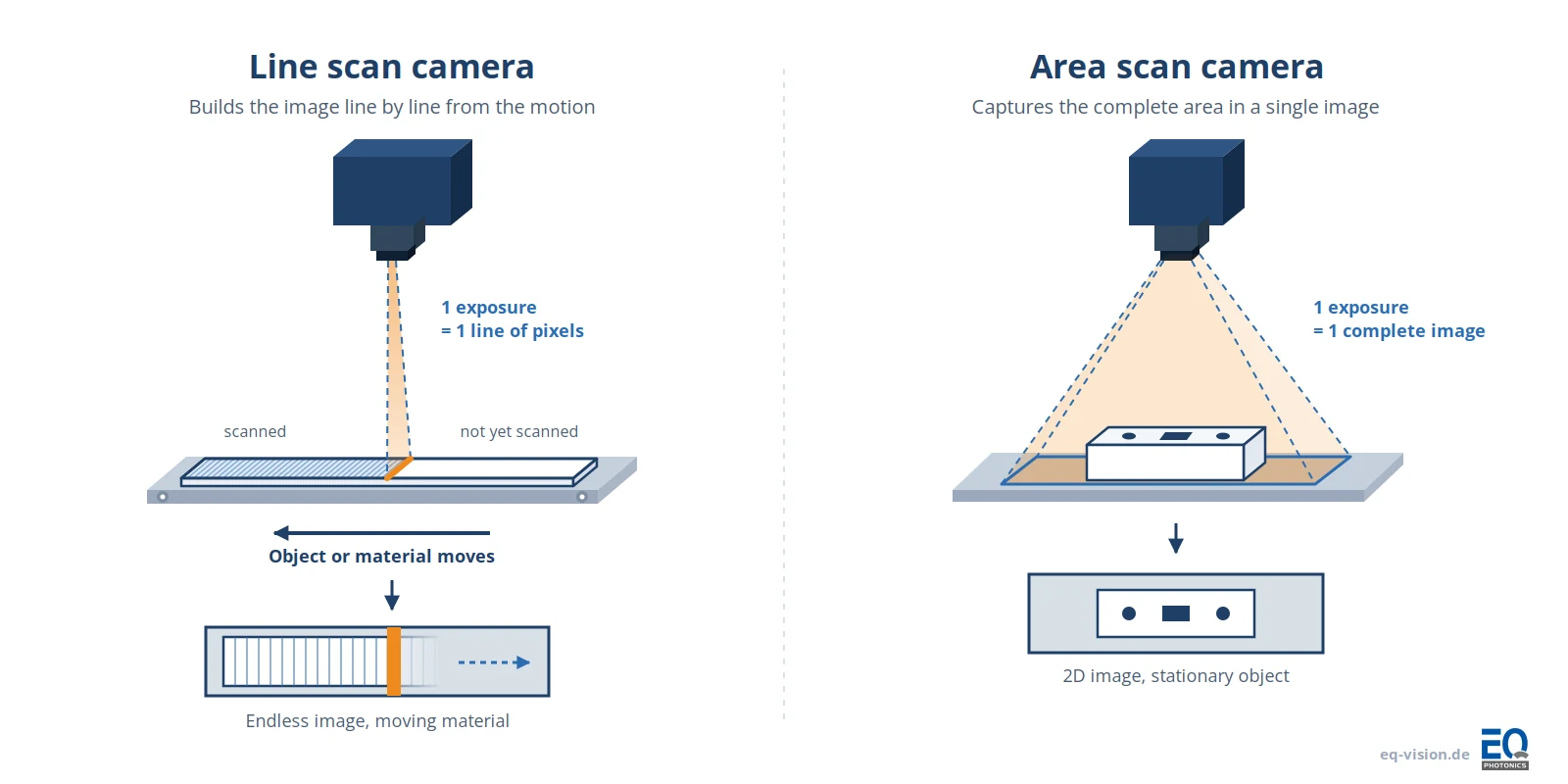
In short: An area scan camera captures a complete image. A line scan camera builds the image from motion.
The key question is therefore: When is a line scan camera the right choice, and when an area scan camera?
Area scan vs. line scan – orientation in 30 seconds
- Area scan camera: the right choice when an object or inspection area can be captured completely in a single image.
- Line scan camera: the right choice when material runs continuously and the image is built line by line from the motion.
- Critical for the selection: inspection feature, motion, field of view, resolution, lighting, lens, interface and integration.
- Not sure? Then do not jump straight into the product list – have the application assessed first.
Before selecting a camera: what to clarify about the area scan vs. line scan question
In practice, the decision is not made by a single datasheet value but by the interplay of inspection task, object motion, image quality and integration. The answer therefore does not depend on resolution or speed alone. What matters is:
- Object and inspection feature
- Motion and process stability
- Field of view and working distance
- Lighting and contrast
- Lens and sensor
- Interface and data volume
- Installation space and integration
If these factors do not fit together, even the most powerful camera will not help. It may deliver an image, but not a reliable inspection.
When an area scan camera is the right candidate
An area scan camera is often the right direction when your inspection object can be captured as a defined area. That means: the relevant object or inspection area fits completely into the field of view. The camera takes a complete image, which is then evaluated.
When the object can be captured completely in a single image
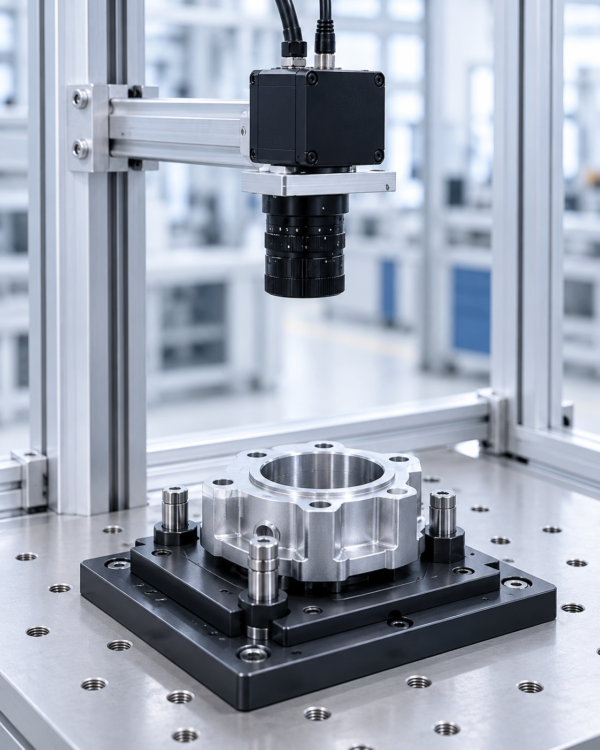
Then an area scan camera is a strong choice. Typical situations include:
- a part rests at an inspection position
- a package passes the camera with a trigger signal
- a code or label needs to be read
- an assembly needs to be checked for completeness
- the position, contour or orientation of an object is relevant
The advantage: the camera sees the scene as one overall image. This allows several features to be evaluated at once, for example position, orientation, shape, code and presence.
Important, however: the object must not merely be visible. The relevant inspection feature must be evaluable in sufficient detail, with stable contrast and reproducible lighting.
When the object is stationary or triggered at a fixed inspection position
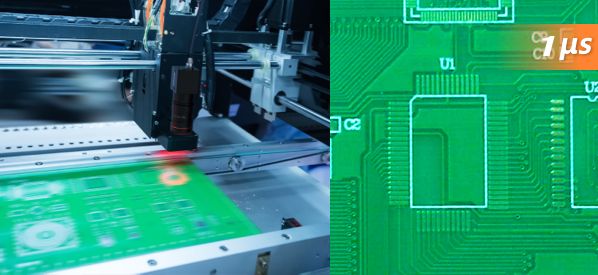
Then area scan is often the natural choice. The image can be captured on a precise trigger. This helps with consistent processes, controlled inspection positions and repeatable imaging conditions. Typical examples:
- part inspection in assembly lines
- presence checks of components
- code and label inspection
- position checks before handling or pick-and-place processes
- completeness checks of sets, assemblies or packaging
If motion is involved, area scan is not automatically ruled out. What matters are exposure time, triggering, object speed and the intended evaluation. For fast or unstable motion, the application should be examined more closely.
When several features on one object need to be inspected at the same time
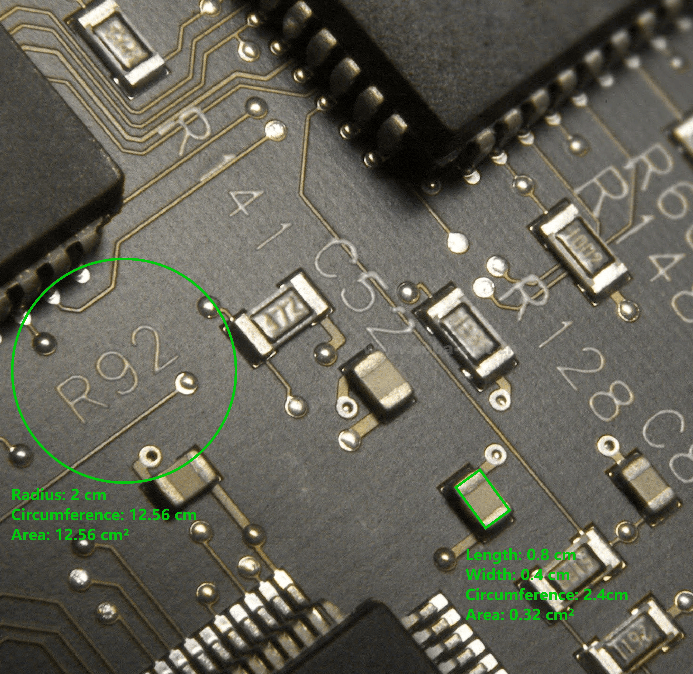
Then an area scan camera can be very strong. A single image can deliver several pieces of information. This helps when not just one point is checked but an object is evaluated as a whole. For example:
- Is the part present?
- Is it positioned correctly?
- Is the code readable?
- Are all components present?
- Are contour and position correct?
- Are there visible deviations?
But here too: area scan is not a universal solution. If the field of view becomes very large while the smallest details must still be resolved, the demands on resolution, lens, lighting and data processing increase. Then not just the camera but the entire imaging concept should be considered.
When a line scan camera is the right candidate
A line scan camera becomes interesting when your inspection object is not captured as a single image but passes the camera continuously. The camera captures the image line by line, and the complete image is created from the motion. Line scan is therefore closely tied to the process.
When material passes the camera continuously
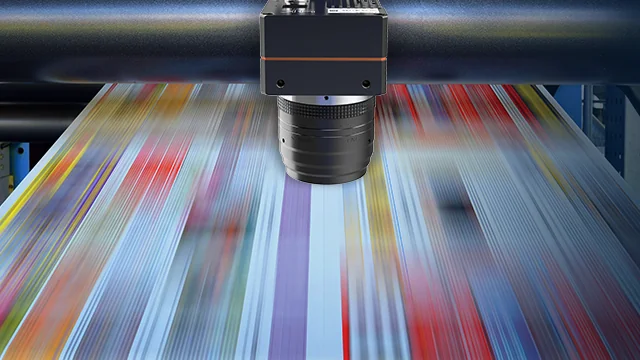
Then a line scan camera is a strong choice. Typical applications include:
- film webs
- paper webs
- textiles
- metal strips
- printed images
- conveyed goods
- long components
- continuous surfaces
In such applications, a single area image is often not enough. The material keeps moving, the relevant inspection length is long, and the surface must be evaluated across the motion. Line scan can make sense here because the image is built up from the movement.
When long, wide or endless surfaces need to be inspected
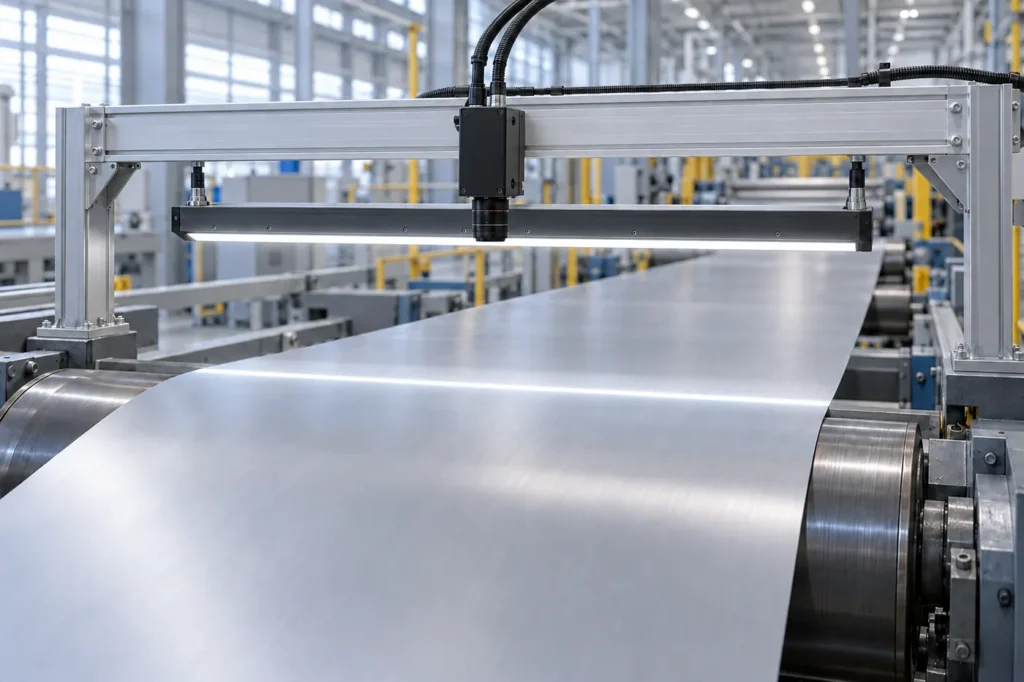
Then area scan can reach its limits. An area scan camera captures whatever fits into the image. With long or endless materials this is often impractical: either the material would have to be stopped, or multiple exposures, multiple cameras or elaborate mechanics would be needed. A line scan camera can be the better direction in such cases, because it captures the surface line by line while the material is moving. Typical inspection tasks:
- detecting surface defects
- finding scratches or inclusions
- inspecting print quality
- detecting pattern defects
- monitoring material webs
- evaluating edges or structures over a distance
When high speed and fine detail recognition come together
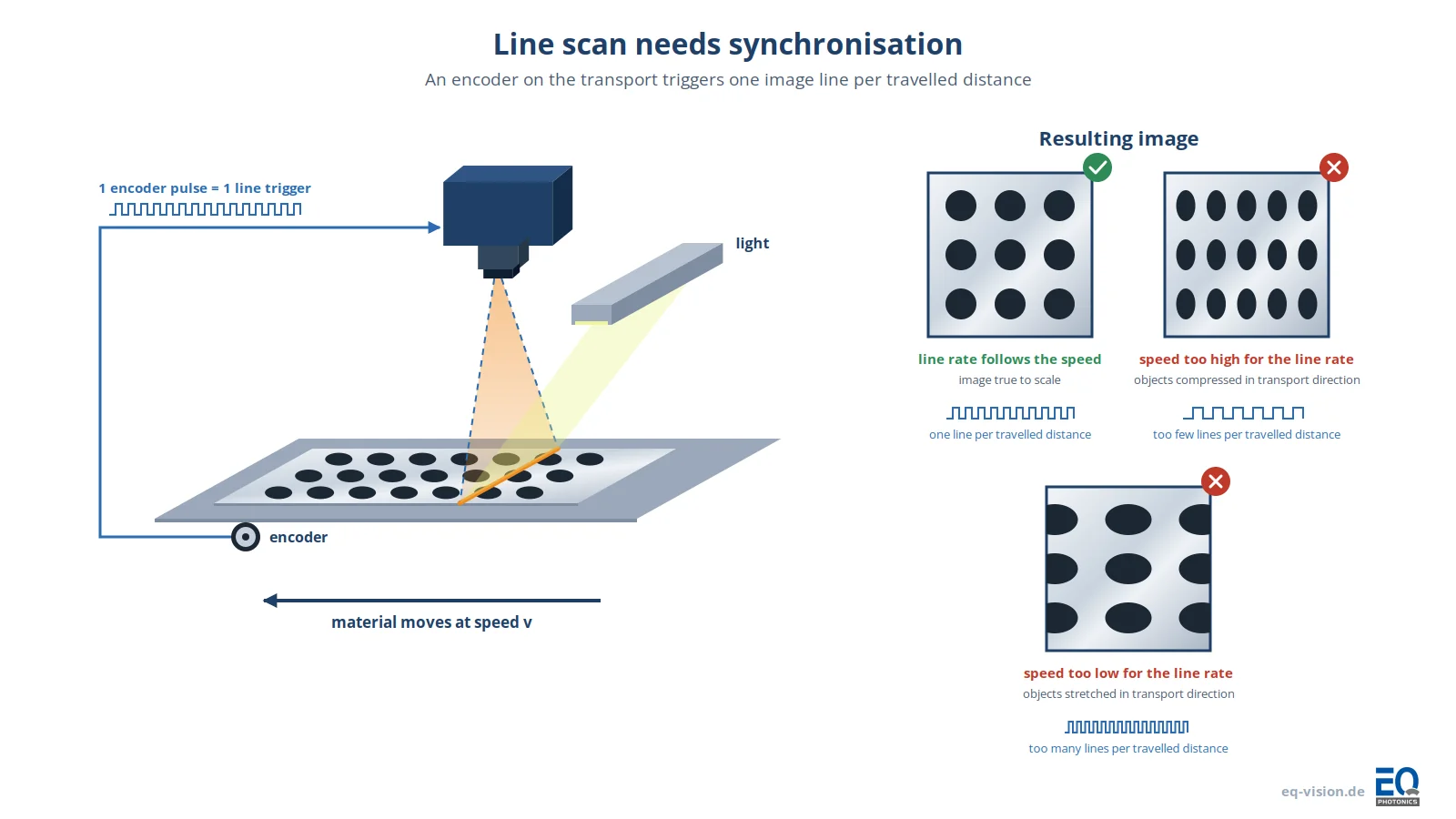
Especially in fast continuous processes, a line scan camera can make sense – but only if motion, synchronization and lighting are under control. This is where many projects fail: the camera fits on paper, but the process does not. With line scan, the following must be considered particularly carefully:
- transport speed
- line rate
- encoder signal
- triggering
- lighting
- data rate
- interface
- evaluation
- mechanical stability
If these points do not work together, the result is distorted, blurred or non-reproducible images.
Area scan or line scan? The key criteria at a glance
The following overview helps with a first assessment. It does not replace a technical review, but it shows which direction is likely.
| If … | Then rather … | Why? | To check |
|---|---|---|---|
| the object fits completely into the field of view | Area scan camera | The camera can capture the relevant area in a single image. | Field of viewResolutionLens |
| the object is stationary or triggered at a defined position | Area scan camera | The image can be captured in a controlled, repeatable way. | Exposure timetriggeringObject position |
| several features on one object need to be inspected at once | Area scan camera | One overall image can capture position, presence, code, contour or completeness together. | evaluationContrastlighting |
| position, presence, code, contour or completeness are the focus | Area scan camera | These inspection tasks can usually be evaluated from a complete 2D image. | Inspection featureImage qualityLight |
| material passes the camera continuously | Line scan camera | The image can be built up line by line from the motion. | SpeedSynchronizationEncoder |
| long, wide or endless surfaces need to be inspected | Line scan camera | The object length does not limit the capture the way a single image does. | line ratedata rateMaterial guidance |
| web material, film, paper, textile, metal strip or print is inspected | Line scan camera | These applications usually run continuously and benefit from line-by-line capture. | lightingContrastProcess stability |
| high speed and fine detail recognition come together | Consider a line scan camera | Line scan can be very capable under the right process conditions. | interfacedata rateevaluation |
| the object is moving but only a limited inspection area is relevant | Consider area scan or line scan | Here the specific process decides, not just the motion. | triggeringExposure timeInspection feature |
| surface, light, installation space or data rate are unclear | Discuss your application with Markus | The camera class alone is not enough for a confident decision. | FeasibilitySamplesIntegration |
Still torn between area scan and line scan?
More about area scan cameras More about line scan camerasFAQ on line scan and area scan cameras
What is the difference between line scan and area scan?
Area scan means the camera captures a complete area in one image – which is why it is also called a frame camera.
Line scan means the camera captures individual image lines. The complete image only emerges from the movement of the object or material – which is why it is also called a line camera.
When is an area scan camera the right choice?
When the inspection object lies completely within the field of view and can be evaluated as an area. Typical tasks include presence, position, code, label, completeness or contour. Importantly, the inspection feature must not merely be visible but reliably evaluable – and this is exactly where light, lens, resolution and process conditions come into play.
When is a line scan camera the right choice?
When material runs continuously or a long surface needs to be inspected. Typical examples are films, paper, textiles, metal strips, printed images or surfaces in continuous flow. Line scan pays off above all when the image can meaningfully be built up from the motion. For that, motion, lighting, synchronization and data rate must work together.
Can area scan also work with moving objects?
Yes. Motion does not automatically mean line scan. Area scan can also fit moving objects if the image is triggered cleanly, the exposure time is short enough and the relevant feature appears stably in the image. If the motion is very fast, irregular or hard to synchronize, line scan should at least be evaluated.
When is it worth talking to Markus?
Whenever you get stuck selecting your industrial camera. A brief joint look at the application often helps more than jumping straight into the product list. Send us your inspection goal, object motion, speed and – if available – images, samples or videos from the process. Markus will gladly assess which direction is not only technically feasible but also commercially sound.

“I would not ask about the camera first, but about the process. Is the part stationary? Is it moving? Is it endless? Is it glossy? How fast is it moving? Only then does area scan vs. line scan become a reliable direction.”
If you want to clarify a specific inspection task:
Check feasibility with Markus now Send inquiry